







Silent Archives of History
Cities do not preserve their histories only through monuments that rise proudly above the ground. Much of a city’s true memory lies lower, quiete and often forgotten. Old cemeteries are among the most overlooked yet most revealing historical spaces. They do not argue, explain, or defend themselves. They simply remain—bearing names, dates, languages, and symbols that speak to those willing to look closely. A weathered stone leaning at an angle, a half-buried inscription slowly consumed by roots, a cross or crescent worn smooth by wind and rain—these are not mere remnants. They are evidence. They are testimony. They are, in the most literal sense, the weight of history made visible.
In a city like Harar, whose identity has always been shaped by movement, encounter, and exchange, cemeteries are not marginal spaces. They are essential historical texts. Each tombstone is a page; each inscription, a sentence; each burial ground, a chapter. When such places are neglected, damaged, or erased, history itself becomes fragmented. What was once a continuous narrative becomes a collection of gaps. What was once a record of lives becomes, instead, a record of our indifference toward them.
This reflection arises from a simple visit—one that unexpectedly revealed a much larger question about heritage, responsibility, and memory. What follows is not speculation, but a direct account of what I saw, what I questioned, and what the neglected international cemetery near the shrine of Aw Ezin reveals about Harar’s past and our present relationship with it. I write not as an academic detached from his subject, but as a witness. And what I witnessed demands not only documentation, but response.
Encountering the Unseen: From Shrine to Cemetery
When we finished visiting the well-known shrine of Aw Ezin—a name that may be a corrupted form of Ezedin, my brother Muhammad Ali casually mentioned that there was once a Greek cemetery nearby. The remark was brief and unassuming—almost an afterthought—but it immediately stirred my curiosity. Cemeteries are never “just cemeteries,” especially in a city like Harar. They raise questions about who lived there, how they arrived, how long they stayed, and how they were remembered after silence finally claimed their voices.
As we moved closer to the location he indicated, I attempted to take a photograph by leaning against a high fence. It was impossible. My camera could capture nothing but the barrier before me. The fence did not protect a cemetery—it enclosed farmland. The land inside bore clear signs of cultivation. Corn had been planted there recently. The soil had been turned, used, and claimed for agricultural purposes. It had been claimed, in other words, as though it had no other history, no other claim upon the present.
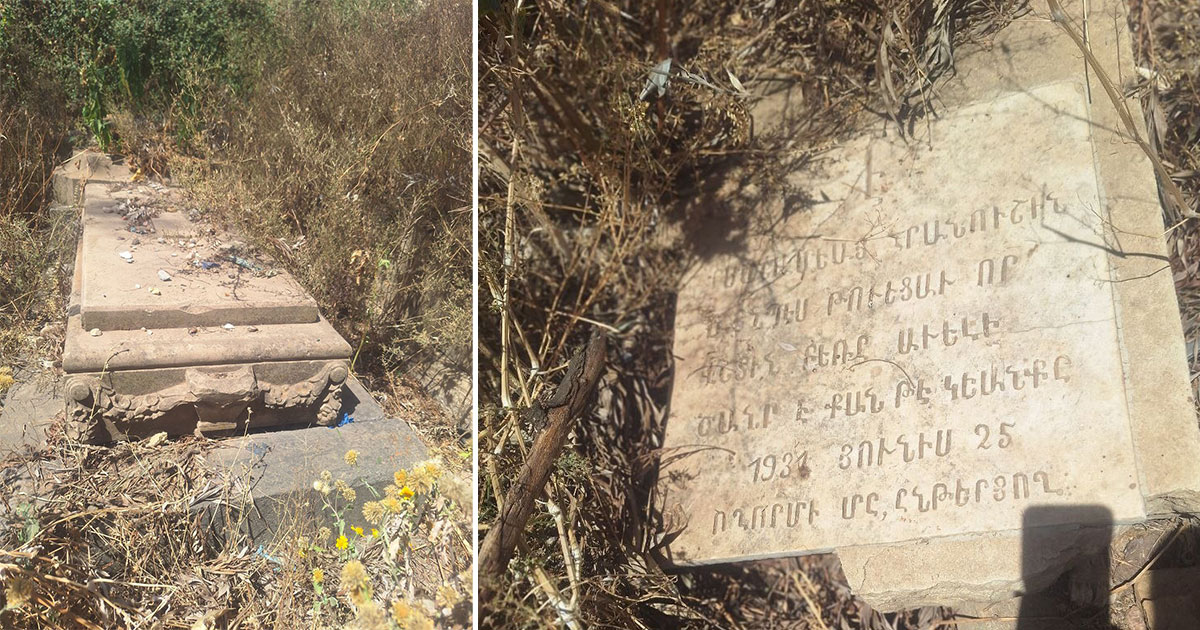
Scattered across this cultivated ground were tombstones, some still standing, others cracked, broken, or partially buried. Here and there, carved stone emerged from the earth like the exposed bones of a body long buried and now carelessly unearthed. The transformation of a burial ground into farmland was not subtle. It was complete, visible, and deeply unsettling. No marker indicated what this place had once been. No fence protected it from further violation. No sign invited reflection or respect. There was only the corn, the broken stones, and the silence of those who could no longer speak.
Crossing the Threshold: Entering the Cemetery
Faced with this scene, I felt I had no choice but to enter. When I searched for the entrance, the Iron Gate—which I assumed would be firmly locked—was tied only with an electric cable, loosely wound, easily loosened. There was no sign, no warning, no indication that this was a protected or even recognized heritage site. There was no suggestion that anyone had thought about this place at all, except perhaps to calculate its utility for planting. I opened the gate easily. Together with my brother and teacher, I stepped inside.
The moment we entered, the contrast between what this place had been and what it had become grew even more striking. This was not an ordinary burial ground. The tombstones were made with care and skill. Some were clearly imported—marble and granite cut to European specifications and transported at considerable expense across oceans and continents. Others were crafted locally by highly skilled stonemasons working under the direction of grieving families or communities. Their shapes, materials, and inscriptions reflected traditions that were not local to Harar alone. Here was an Orthodox cross. There, an Armenian inscription. Elsewhere, Italian marble weathered by decades of Harari sun and rain.
On several headstones were inscriptions written in Greek, Armenian, Italian, French, and other European languages. Names, dates, and identifying phrases were carefully carved, deeply incised, intended to preserve identity long after death. Some included epitaphs—brief messages from the living to the dead, or from the dead to posterity. “Beloved husband.” “Devoted mother.” “Rest in peace.” “Eternal memory.” These were not anonymous graves. Each stone represented a life once lived fully, consciously, and with the expectation of remembrance. Each name was once spoken daily, called at market stalls and dinner tables, whispered in moments of tenderness, cried out in moments of grief.
Historical sources indicate that the earliest arrival of foreigners of non-Muslim faith in Harar began from the time of Egyptian occupation in 1875. Prior to this, the only British traveler mentioned is Richard Burton in 1854, whose famous—or infamous—visit to Harar was undertaken in disguise, at considerable personal risk. Between Burton’s solitary journey and the Egyptian occupation lies a gap of twenty-one years. Between the Egyptian occupation and the present lies nearly a century and a half of continuous, if shifting, foreign presence in the city.
Yet now, these stones stood neglected—covered in dirt, cracked by time, undermined by roots, and threatened by complete erasure. Some had been deliberately broken. Others had been displaced, moved from their original positions to accommodate planting rows. Still others had sunk so deeply into the earth that only their uppermost curves remained visible, like drowning faces disappearing beneath dark water.
Harar as a City of Many Lives
As we moved among the graves, Muhammad explained that Armenians, Greeks, Italians, French, Germans, Maltese, and others had lived in Harar hundreds of years ago. He spoke not from books alone, but from inherited knowledge—stories passed down through families, fragments of memory preserved in a city where the past is never quite past. Some came as traders, drawn by Harar’s renowned markets and its position along established caravan routes linking the Ethiopian highlands to the Gulf of Aden and the Red Sea. Some came as craftsmen, bringing skills—metalwork, masonry, tailoring, carpentry—that were eagerly adopted by local artisans. Some came as scholars, as advisors, as merchants of luxury goods and everyday necessities. Others arrived under various professional guises whose precise nature has now been lost to time.
Harar, situated at a crossroads of trade and culture, naturally attracted people from far beyond its immediate region. Its walls, famously described by Burton as protecting “a city of saints and coffee,” did not exclude the foreigner. They enclosed a space of encounter—sometimes tense, often fruitful, always dynamic. The city’s famous Jugol, its historic wall, was never a barrier to movement. It was a membrane, permeable and selective, regulating contact without preventing it entirely.
Some of these individuals died while living in Harar and were buried here. In certain cases, their remains were later collected by surviving family members, by consular officials, or by religious communities and returned to their countries of origin. A few were disinterred and reburied in the great European cemeteries of Aden or Cairo, way stations on the long journey home. Others remained, their graves becoming part of Harar’s physical and historical landscape, absorbed into the very soil of the city that had hosted them in life.
This reality confirms a truth often overlooked in contemporary discourse about Harar’s identity: Harar has always been international. Its history cannot be confined within ethnic, linguistic, or national boundaries. To speak of Harar as purely Ethiopian, purely Islamic, purely Harari, is to erase centuries of exchange that shaped the city into what it became. The presence of this cemetery alone is evidence of long-standing global connections—trade routes that stretched from the Mediterranean to the Indian Ocean, diplomatic networks that linked Ethiopian rulers to Ottoman pashas and European monarchs, commercial partnerships that bound together merchants from Athens, Marseille, and Harar in mutual dependence.
The cemetery, therefore, is not a foreign intrusion into Harar’s history. It is a record of Harar’s openness—a testament to the city’s role as a place of encounter. It does not diminish Harari identity to acknowledge that others lived and died within its walls. It enlarges our understanding of what that identity has meant across time.
Reading the Stones: Language, Identity, and Loss
After photographing several inscriptions—many so obscured by dust, lichen, and neglect that their characters were barely legible—we returned to the city. Later, Muhammad attempted to read and interpret some of the inscriptions using AI technology. He succeeded in translating one of them, revealing details that had remained hidden to us at the site: a name, a date of birth, a date of death, a place of origin, a phrase of remembrance from grieving loved ones.
This small act of translation revealed a much larger truth: how much information lies dormant in these stones, waiting to be studied. Each inscription potentially contains clues about migration patterns, professional networks, family structures, religious affiliations, and practices of belonging. Each gravestone is a primary source document, contemporaneous with the life it commemorates and the death it marks. Yet without systematic documentation—without a comprehensive survey, without academic attention, without public awareness—such knowledge remains vulnerable to permanent and irreversible loss.
Cemeteries like this one are not only burial grounds; they are open-air archives. Unlike written documents stored in libraries or manuscripts preserved in museums, they cannot be easily replaced or reconstructed once destroyed. A torn page can be repaired. A faded manuscript can be treated and conserved. But a shattered gravestone, its inscription scattered across cultivated soil, is lost forever. The names it carried, the dates it preserved, the memory it embodied—all vanish with the stone itself.
What makes this loss particularly poignant is its proximity to preservation. The shrine of Aw Ezin, just across the way, is maintained, visited, respected. Pilgrims come from across the region and beyond. The tomb is cared for. The site is recognized. Yet the cemetery, separated from the shrine by only a narrow path, has received no such attention. One space of memory is honored; another, equally authentic, is erased. One community of the dead is remembered; another, no less deserving, is forgotten. This is not a failure of resources alone. It is a failure of recognition.
Ownership, Authority, and the Question of Heritage
Standing among the damaged graves, my feet planted in soil that had been turned for corn but should have been left undisturbed for eternity, I found myself asking questions that demanded serious reflection.
Who owns this cemetery now? The question is not as simple as it appears. Legal ownership, if it exists at all, may lie with any number of entities—a government ministry, a municipal authority, a religious institution, a private landholder. But legal ownership is not the same as moral stewardship. One can hold title to land while abandoning responsibility for what lies within it. One can inherit property without inheriting obligation.
Who has the authority to decide its fate? If decisions about this place have been made—and the presence of corn planted among graves suggests they have—who made them? On what basis? With what consultation? According to what criteria of value? No community was asked whether this burial ground should be converted to agriculture. No descendants were consulted, for no descendants remain to be consulted. No heritage authority was invited to assess the significance of what stood here. No public discussion preceded the transformation of a cemetery into a farm plot.
Who allowed it to be converted into farmland? This is not a rhetorical question. Some person, or some office, or some institution gave permission for this land to be used in this way. That permission may have been explicit—a formal authorization, a signed document, an official decision. It may have been implicit—a failure to enforce protection, a neglect of oversight, an absence of objection. Either way, responsibility exists. Either way, accountability is possible.
More importantly, who is responsible now? Old cemeteries—especially those containing the remains of diverse communities whose descendants have dispersed across continents and generations—should not be treated as abandoned land simply because no immediate family members remain to defend them. Heritage does not require continuous occupation to retain value. Its value lies in historical significance, not present utility. The absence of claimants does not nullify obligation. It concentrates it.
If this place is not heritage, then what is? If a 150-year-old cemetery containing the graves of dozens of individuals from a dozen nations, inscribed in multiple languages, reflecting centuries of global connection, does not qualify as cultural heritage worthy of protection, then the term has lost all meaning. If this place can be plowed under without objection, then no place is secure. If these graves can be broken and scattered without response, then every cemetery, every memorial, every marker of lives once lived is vulnerable to the same dismissal.
Comparative Reflection and Academic Responsibility
In many cities with similarly complex histories, international cemeteries are protected precisely because they represent moments of encounter and coexistence that define urban identity. Even when the histories involved are painful or complicated—even when they involve colonialism, occupation, or exploitation—preservation is seen as an ethical obligation rather than an inconvenience. The past is not sanitized. It is confronted. It is studied. It is remembered.
Such cemeteries are often mapped and recorded, their inscriptions transcribed and translated, their histories published and taught. They are legally protected, designated as historic sites under national or local preservation laws. They are modestly maintained—not necessarily restored or embellished, but kept stable, prevented from further decay. They are made accessible to researchers and visitors, recognized as resources for education and reflection. They are not celebrated uncritically, but respected responsibly. The distinction is crucial.
Against this background, the condition of the international cemetery in Harar raises difficult questions—not primarily about resources, but about recognition and priority. As I stood there, surrounded by broken stone and growing corn, another question emerged with increasing urgency: Could this cemetery not form the basis of serious academic research? Even without excavation, a careful study could document everything visible above ground. Inscriptions could be photographed, transcribed, and translated. Burial styles and materials could be catalogued and analyzed. Patterns of origin and settlement could be traced through names, dates, and epitaphs.
A well-designed doctoral dissertation could be conducted based solely on what already exists in this small, neglected plot. Not in the distant future, when funding appears or interest awakens, but now, before more is lost. Each season of planting risks further damage. Each rain further erodes weathered inscriptions. Each year without documentation marks the permanent disappearance of information that will never be recovered.
Such research would not only benefit historians. It would contribute directly to heritage preservation by establishing the significance of what remains. It would support cultural tourism by adding a new dimension to Harar’s already rich attractions. It would increase public awareness, both locally and internationally, of the city’s cosmopolitan heritage. It would demonstrate, through concrete action, that these lives and deaths matter.
Cemeteries, Dignity, and Moral Obligation
Beyond policy and research, beyond legal frameworks and academic projects, lies a deeper issue that resists easy resolution: human dignity. The dead cannot speak for themselves. They cannot protest the plowing of their graves or the scattering of their headstones. They cannot petition authorities or write letters to newspapers. When their graves are broken or ignored, it is the living who must answer—not on behalf of the dead, who are beyond all injury, but on behalf of ourselves and the kind of society we choose to inhabit.
Respecting cemeteries is not about honoring foreigners over locals. It is not about privileging one community of the dead above another. It is about honoring human life and human memory as such, without regard to origin or identity. The Armenian merchant buried in Harar in 1892 was someone’s father, someone’s husband, someone’s friend. The Greek craftsman buried beside him was someone’s son. They lived. They loved. They worked. They died. They were mourned. They were buried with care and intention. They were promised remembrance.
We who live now have inherited that promise. Not legally, perhaps, and not formally, but morally. When we allow their graves to disappear under cultivation, we are not merely failing to protect old stones. We are breaking faith with the dead and with the living who trusted that their loved ones would not be forgotten. We are saying, through our inaction, that some lives do not matter enough to be remembered. We are declaring, through our neglect, that some deaths are not worthy of respect.
To allow graves to disappear under cultivation is not merely an administrative failure. It is a moral failure—a choice, however unexamined, to value present convenience over permanent memory.
Conclusion: A Test of Memory and Responsibility
The international cemetery near the shrine of Aw Ezin has not yet vanished completely. That fact alone offers hope. Broken stones can be repaired. Displaced markers can be restored. Cultivated land can be returned to its original purpose. Inscriptions can be transcribed, translated, and published. The dead can be remembered again.
But hope requires action. It requires recognition that this place matters—not as an obstacle to development, not as an inconvenience to agriculture, not as an abandoned plot awaiting more productive use, but as a record of lives once lived and a testament to Harar’s long history of global connection. Cemeteries like this are not obstacles to progress; they are foundations of historical understanding. They are not burdens to be shed; they are responsibilities to be accepted.
Harar has always been a city where worlds met. Its walls enclosed not separation but encounter. Its markets exchanged not only goods but ideas. Its streets accommodated not only residents but sojourners. Its cemeteries received not only locals but strangers who became, in death, permanent residents of the city that had hosted them in life. The neglect of the international cemetery, therefore, is not only a loss for historians. It is a loss for Harar itself—an erosion of the very complexity that makes the city distinctive. To restore this place is not to import foreign values. It is to recover Harari values that have been, for whatever reason, temporarily forgotten.
This is the truth that the neglected international cemetery confirms. This is the truth that its broken stones still testify. And this is the truth that will be lost if we allow these graves to disappear without response. What remains is a choice—not only for authorities, not only for heritage professionals, not only for academics, but for all who care about history and its preservation. The choice is stark in its simplicity and profound in its implications: to allow silence to erase memory, or to let recognition restore dignity.
I have written this account because silence is no longer acceptable. I have documented what I saw because documentation is the precondition for preservation. I have asked difficult questions because unanswered questions become, in time, unasked questions—and eventually, unaskable questions. The dead cannot speak. But we can. And we must.
Contributed by Teshome Berhanu Kemal