





A meditation on migration and disappearance
In a sunlit veranda in Merkato, in a neighborhood known as Abba Koran Sefer, a young boy once stood transfixed by the canvases of his neighbor, Jemil Shifa. Each morning, Jemil carried his paintings into the open air to study them in natural light, unaware that a sixth-grader lingered nearby, quietly tracing their lines in an almost obsessive act of imitation.
Nearly three decades later, that boy—now 38-year-old Ashenafe Mestika—still points to those mornings as the catalyst for a career shaped by 15 years of full-time dedication to painting. But the child who once copied what he saw has evolved into an artist intent on capturing something far less tangible: the fractured inner lives of a generation in motion.
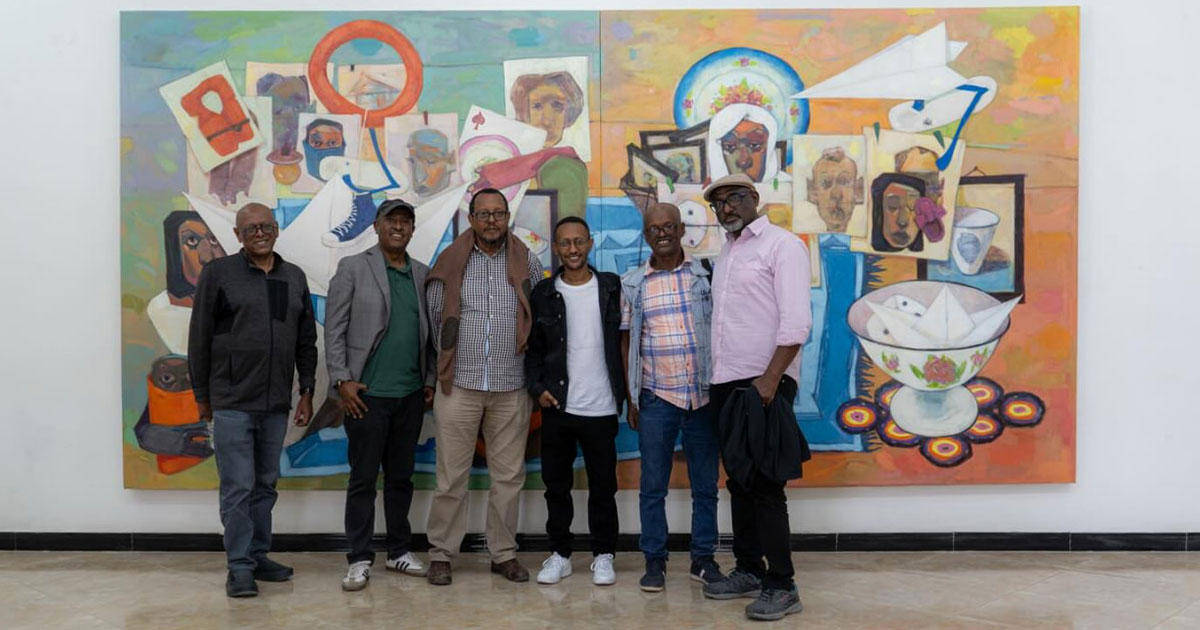
His latest exhibition, Entangled Stories—or Teleflef Tarikoch in Amharic—ran from April 4 to May 3 at the New Cinema Complex. It offers an unflinching meditation on one of the defining crises of the modern era: forced migration.
Across 19 works, some stretching nearly five meters, Ashenafe examines the precarious space between departure and arrival — a liminal state where hope and loss exist in uneasy tension. The exhibition does not narrate migration as a linear journey, but as a disorienting condition.
“Through this exhibition, I explore the idea of ‘entanglement,’” Ashenafe told The Reporter. “It is where hope and loss, memory and emptiness, and the physical and psychological toll of crossing borders become inseparable — especially when the destination remains uncertain.”
The works are bound less by narrative than by atmosphere — what the artist describes as a single, “haunting umbrella.” Distorted human forms recur across the canvases: a head fused to a limb, bodies with multiple hands, figures suspended in states of incompletion. These are not abstractions for their own sake, but visual metaphors for dislocation.
One question reverberates through the exhibition: “How long now is?”
It is not a query about time in any conventional sense. Instead, it gestures toward the psychological weight of waiting — of lives stalled in transit, or cut short without resolution. The fragmented bodies evoke what Ashenafe calls the “disappeared”: migrants whose journeys ended without record, their fates unknown, their absence unresolved.
To anchor this sense of loss, Ashenafe threads familiar domestic objects into his compositions — kitchen utensils, household tools — artifacts imbued with cultural memory. Set against stark, often disquieting backdrops, these items function as both relic and witness.
“These objects carry the warmth of home,” he said. “They hold the memory of fathers, mothers, sisters and brothers — of lives that existed before. They are not just tools; they are storytellers.”
In juxtaposing the intimate with the anonymous, Ashenafe attempts to construct what amounts to both memorial and indictment. The works ask viewers to look beyond the abstraction of migration statistics and confront the human stories that vanish within them — stories that, like his figures, remain suspended between presence and disappearance.
Ashenafe’s influence extends beyond the canvas. For the past 12 years, he has led the Ashu Mestika Archive, a long-term documentation project born from a gap he encountered as a student at the Alle School of Fine Arts and Design.
“The biggest challenge was documentation,” he said. “As students, our opportunity to see the work of Ethiopian artists was very limited. We were learning largely from foreign references.”
The archive seeks to correct that imbalance. Through long-form interviews with both established and emerging artists, it aims to build a living record of Ethiopia’s contemporary art movement — a project he envisions unfolding over two decades and serving as a resource for future scholars.
For fellow artist and curator Tamerat Siltan, Ashenafe’s trajectory reflects a broader shift within the community — what he describes as a necessary awakening.
He points to a progression in Ashenafe’s work, from his 2015 debut Internal Expression and Beyond to the more overt Grant Me My Sovereign Death in 2024, as evidence of a deepening engagement with social realities.
“Art should document the thinking of its time,” Tamerat said. “But it must also challenge people — it should provoke, unsettle, and push toward something better.”
Yet both artists are candid about the structural constraints facing the art sector. In a country of more than 120 million people, the domestic market remains underdeveloped, hampered by weak institutions and limited state support.
“The problem is institutional,” Tamerat said. “Too often, those in positions of authority lack a basic understanding of the arts.” He cited the Ethiopian Artists Association as one example, arguing that stagnant leadership has failed to advocate effectively for its members.
The consequences are tangible. While Ashenafe has exhibited internationally—including a residency at the Millerntor Gallery in Hamburg, where he produced a 3.5-by-8-meter mural at St. Pauli’s stadium—the conditions in Addis Ababa remain constrained.
“We are working in an environment where even basic materials are difficult to access,” Tamerat said. “Sometimes it feels like we are scavenging just to continue.”
Compounding the challenge is a tax regime that classifies art supplies as luxury goods, placing additional strain on artists operating within already narrow margins. Tamerat argues that this reflects a broader failure to recognize the economic and cultural potential of the creative sector.
“Art can be a serious economic driver,” he said. “It can generate revenue, attract tourism and project a country’s intellectual and cultural identity to the world. But Ethiopia has not yet treated it that way.”
The absence of coordinated support, he added, affects every layer of the ecosystem — from access to materials and studio space to the scarcity of exhibition venues. Government engagement, in his view, remains largely limited to taxation, with little attention paid to the conditions under which artists work.
“Who is asking how artists sustain themselves?” he said. “Where they get materials, how they access space — these questions are largely ignored.”
Despite these constraints, Ashenafe continues to work with a sense of forward motion. He describes his practice as one of continuity, currently extending into a documentary series focused on video artists. He credits his persistence to a supportive family and early mentorship from figures like Gizachew Kebede, who introduced him to professional studios as a teenager.
When asked what guidance he offers younger artists, Ashenafe resists easy prescriptions. Instead, he returns to intent and responsibility.
“Ask yourself why you chose this path,” he said. “And make sure what you contribute is worthy of that choice. The work demands your full commitment.”