





Where Words Often Fail
 It was a quiet morning at Grace Care Homes in Addis Ababa when, for one elderly resident, the haze of dementia briefly receded. The change came not through medication or intervention, but through music.
As the opening chords of “Astawesalew,” a classic performed by Lemma Demissew during the golden era of Amharic music, drifted through the corridors, the woman rose from her seat. She moved toward the musicians, asked for the song by name, and began to sing. Moments later, she was dancing—her memory, if only temporarily, restored by melody. For relatives and staff gathered nearby, the scene was striking in its immediacy.
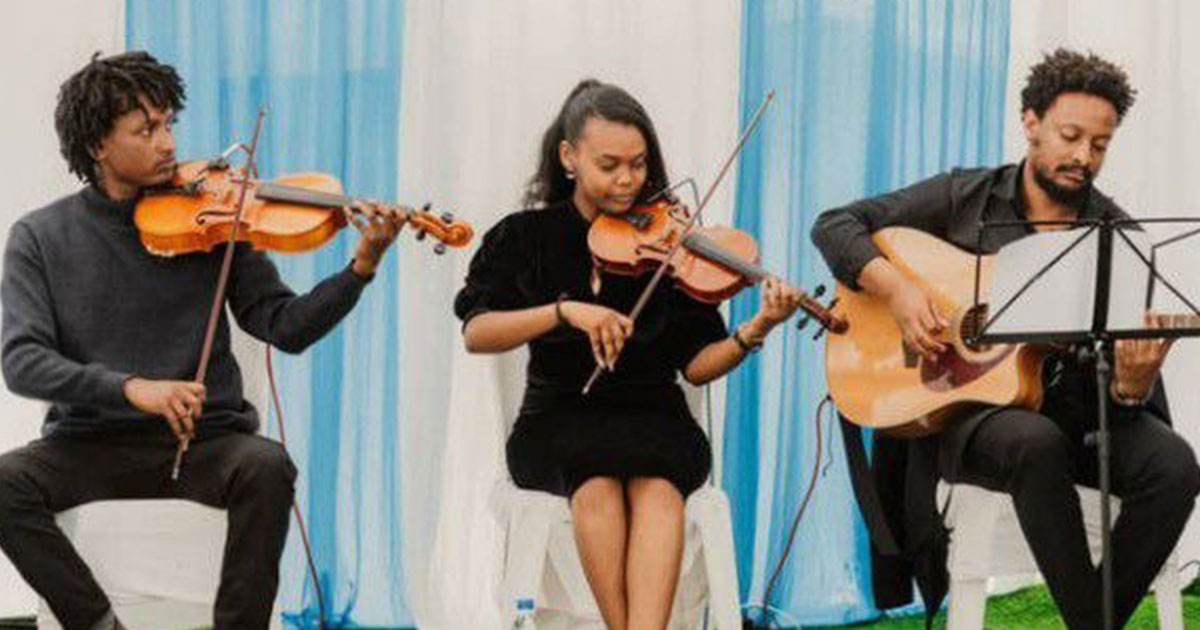
That moment would go on to inspire Kine-Fews, an Addis Ababa–based initiative founded in April 2023 that explores the therapeutic power of art and music.
Positioned at the intersection of psychology and the arts, Kine-Fews reflects a growing body of research that recognizes art therapy as an evidence-based complement to mental health care.
In Ethiopia, where access to formal psychiatric services remains limited, the initiative’s founders—graduates of Addis Ababa University’s colleges of Behavioral Science and Performing Arts—have turned to creative practice as a means of addressing psychological distress. Its name encapsulates that mission: kine (art) and fews (healing).
“It was an emotional moment that pushed us to recognize the healing potential of art and music,” said Alazar Tesfaye, the initiative’s founder and manager.
Under his direction, Kine-Fews has assembled a multidisciplinary team that includes singers, instrumentalists, architects, medical doctors and professional psychologists.
The initiative’s premise is supported, in part, by academic research. Moges Ayele, a psychology professor at Addis Ababa University, notes that music can serve as a powerful cognitive cue, linking rhythm and melody to personal and factual memory.
“Drawing or painting can also help individuals externalize emotion,” he said. “It creates visual associations that support recall and expression.” While Ethiopia lacks extensive longitudinal studies on the subject, he added, international research suggests that art therapy is most effective when integrated with conventional treatment models.
Moges cautioned, however, that such interventions require professional oversight. “Art therapy can be a potent tool,” he said, “but only when delivered by trained practitioners.”
Kine-Fews attempts to follow that model. The group collects participant feedback, including pre- and post-session self-assessments, alongside facilitator observations. According to Alazar, the data—though still limited—points to consistent reductions in stress and anxiety, suggesting that creative engagement can help regulate emotional states.
The approach also intersects with a broader social challenge. In Ethiopia, mental health conditions are often stigmatized, leaving many individuals reluctant to seek help or unable to articulate their experiences. Kine-Fews, Alazar said, was designed in part to address that gap.
“Not everyone can express what they feel in words,” he said. “Art creates another pathway—one that feels safe, communal and, at times, even playful.”
He added that participants, ranging from children to older adults, often show marked improvements in their willingness to engage and communicate. Group painting sessions, in particular, appear to foster openness, as individuals gradually move from observation to participation.
One participant in the “Brush & Balance” program—where guided painting sessions are facilitated by trained counselors—described the experience as a form of externalization. The act of painting, they said, allowed them to “see their internal weight take a physical form on the canvas,” rendering it more manageable.
The integration of the arts into medical and therapeutic practice is no longer peripheral. Institutions such as the World Health Organization and the African Union have increasingly framed artistic practice as a legitimate component of public health strategy.
In 2019, the WHO published a scoping review of more than 3,000 studies, concluding that creative disciplines—including music, painting, storytelling and dance—can play a role not only in prevention, but also in the treatment and management of chronic conditions.
Across Africa, that shift is taking on institutional form. In Kenya, the Trust for Indigenous Culture and Health (TICAH) has integrated cultural expression into community health programs, while in South Africa, MusicWorks has focused on music-based interventions for vulnerable populations.
Regional momentum has also been reflected at the policy level: during African Union Healthy Lifestyle Day 2025, the African Union highlighted family mental health and endorsed artistic psychosocial support, signaling a broader transition from viewing the arts as ancillary to recognizing them as functional tools of care.
Within Ethiopia, Kine-Fews has also begun to embed itself in this emerging landscape through partnerships with institutions such as Aha Psychological Service, Mental Health Addis, Nadora Wellness Center and Plan International. Its programming has also been featured in public events, including World Mental Health Day activities at the United Nations Economic Commission for Africa, alongside the Alenilachu Charitable Organization, and observances of International Peace Day.
The initiative’s client base spans both public and private institutions, including Saint Paul’s Hospital Millennium Medical College, First Consult, FSD Ethiopia and the Setaweet Movement.
For Hiyab Tekle, a resident navigating what she describes as minor but persistent mental health challenges, art therapy offered a form of clarity that had eluded more conventional approaches.
“Music and painting helped me release emotions I couldn’t explain, especially sadness and anxiety,” she said. Since beginning the sessions, she reports improved sleep, a greater sense of calm, and fewer intrusive thoughts.
She recalled one session in particular, when the act of painting prompted an unexpected moment of insight. “While painting, I suddenly understood the source of my anger—it felt like a weight lifted,” she said. Unlike more passive coping mechanisms, she added, the creative process fosters a sense of agency. “Art and music make me feel actively involved in my healing.”
That sense of control extends to others. Rediet, a business student at Addis Ababa University, describes using religious music as a stabilizing force in moments of stress.
“I use religious music to take a step back and breathe when I’m overwhelmed,” she said. “The lyrics and rhythms remind me that there is still beauty to be seen.”
Contributed by Bemnet Seifu