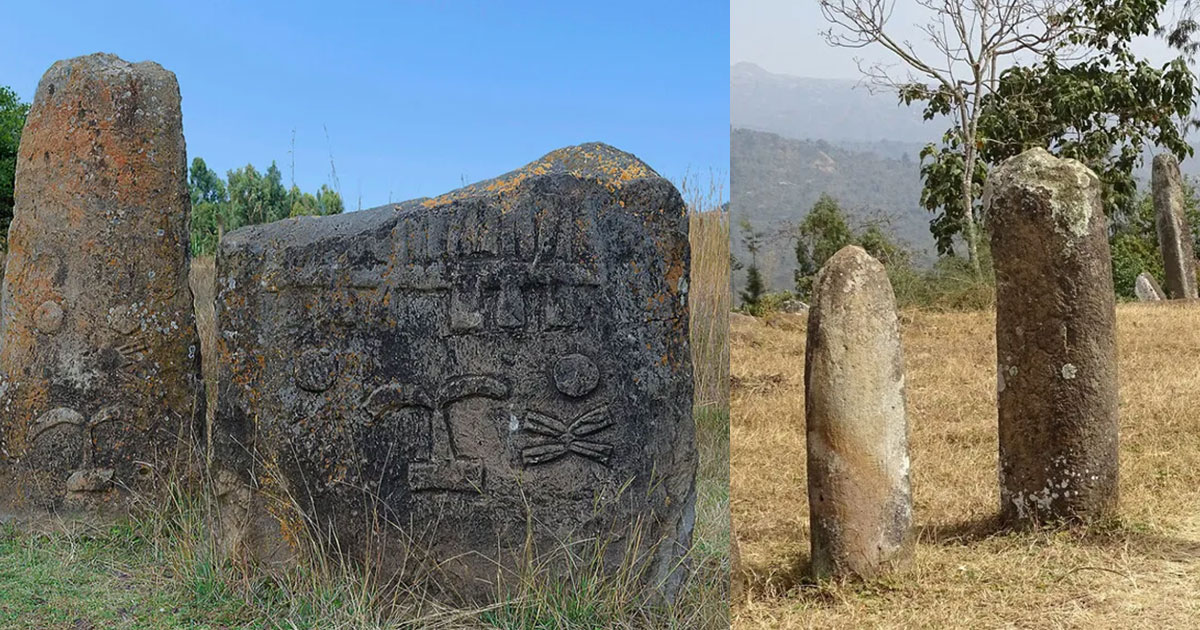






Across the wind-scoured plateaus of Tigray and the lush hills of Gedeo Zone, Ethiopia preserves a silent, stone-hewn archive unlike almost any other on Earth. While global narratives of the megalithic age often gravitate toward Stonehenge and the dolmens of Western Europe, recent scholarship argues that Ethiopia stands among the world’s most significant — yet frequently overlooked — landscapes of monumental stone architecture.
In his study, “Megalithic Landscapes of Ethiopia from Prehistory to the Modern Era,” Isaac Samuel contends that these structures are not merely archaeological remnants. Ethiopia, he suggests, represents a rare cultural continuum where the practice of erecting stelae did not vanish with prehistory but endured across centuries. International bodies such as UNESCO and generations of anthropologists have similarly pointed to this continuity, describing Ethiopia as a civilizational bridge between ancient ritual and living heritage.
Such landscapes are more than historical curiosities. They anchor identity, embodying a persistent human impulse to inscribe memory and power into stone. From the soaring obelisks of Aksum to the stelae fields of Tiya, Ethiopia’s monuments reveal a tradition that evolved rather than disappeared.
This sense of cultural depth is echoed by scholars and interpreters of Ethiopian history, including Yves-Marie Stranger, a novelist and translator whose work has long engaged with the country’s heritage. Stranger views Ethiopia’s monuments as testaments to endurance — many surviving for millennia — yet warns of a paradoxical modern threat: neglect coupled with restoration practices that risk undermining authenticity.
His concern centers on the use of contemporary materials, particularly cement. Such interventions, he argues, may introduce long-term structural stresses while clashing visually with original masonry. The danger is not only physical but aesthetic — the gradual erosion of the rugged integrity that gives these monuments their historical character.
Samuel’s research situates Ethiopia within a global context of megalithic traditions while emphasizing its singularity. Unlike prehistoric stone cultures elsewhere, he notes, Ethiopia’s monument-building did not end in antiquity. “The construction of stelae in Ethiopia,” he writes, “is not a relic of a forgotten past, but part of a tradition that persisted into historical and even modern eras.”
That continuity stretches deep into prehistory. Samuel traces its origins to the Neolithic communities of Mahal Teglinos, associated with the Gash Group between roughly 3000 and 1500 B.C., where early funerary stelae appeared as modest slabs and pillars. Over time, these forms expanded in scale and ambition, culminating in the proto-Aksumite monuments of Beta Giyorgis.
By the emergence of Aksum as an urban and political center in the late first century C.E., the tradition had reached extraordinary proportions. The royal cemeteries became home to towering stelae that Samuel describes as among the largest single blocks of stone ever raised by human hands.
These were not simple markers. Carved from nepheline syenite quarried kilometers away, the monuments were engineered to imitate multi-story buildings, complete with false doors, window frames, and the distinctive “monkey-head” beam motifs rendered in low relief. The largest, commonly known as Stela 1, is estimated to have measured about 33 meters and weighed more than 500 tonnes — a scale that still provokes awe and technical curiosity.
Echoing Samuel’s emphasis on scale and symbolism, Stranger told The Reporter that the colossal proportions of the stelae speak directly to the stature of Aksum as a leading civilization of the ancient world. Monumental complexes, including the Temple of Yeha, stand, he said, as material evidence of accumulated wealth, engineering sophistication, and the administrative capacity required to marshal labor and resources on a vast scale.
For Stranger, the monuments also illuminate a web of historical connections extending far beyond the northern highlands. Architectural and inscriptional parallels, he argued, point to exchanges spanning the Red Sea corridor — from Yemen to Egypt, with Meroë as a pivotal intermediary. That connectivity, he noted, is underscored by accounts that an Aksumite ruler once erected a stela at Meroë to commemorate a military triumph, embedding political authority within a shared monumental vocabulary.
The practice of inscribing power into stone, Stranger added, persisted well into late antiquity. He points to the Greek traveler Cosmas Indicopleustes, who recorded royal inscriptions at the behest of King Kaleb — also known as Elesbaan — as the monarch prepared his campaign into Himyar in present-day Yemen. Such records, Stranger observed, reveal how diplomacy, warfare, and memory converged in stone, ensuring that statecraft itself acquired a durable, physical form.
Samuel’s analysis similarly challenges any notion of regional isolation. Archaeological evidence, he writes, indicates that at least four largely independent traditions of stelae construction emerged across Ethiopia’s northern, eastern, central, and southern regions. In the Gedeo Zone and Sidama Region, megalithic expression diverged into distinctive forms, from phallic stones to anthropomorphic stelae. This geographic diversity suggests not fragmentation but a deeply embedded, decentralized cultural impulse.
Yet continuity did not preclude transformation. With the formal adoption of Christianity in the fourth century, the ideological landscape shifted. Royal funerary architecture evolved toward subterranean hypogeal tombs and masonry superstructures, exemplified by monuments such as the Tomb of the False Door. In time, churches constructed atop royal burial sites — including those associated with King Kaleb and Gabra Masqal — signaled an architectural reorientation that preserved sacred geographies even as ritual forms changed.
Samuel ultimately situates Ethiopia’s megalithic heritage within a global frame that complicates conventional prehistoric chronologies. Ethiopia’s stone culture, he concludes, encompasses a wide spectrum of forms — standing stones, dolmens, and tumuli — many bearing dense symbolic and figurative carvings, as seen in the stelae fields of Tiya.
Despite this depth, Stranger contends that Ethiopia’s architectural legacy remains insufficiently recognized internationally. The obscurity, he argues, extends from the iconic obelisks of Aksum to the refined stone-built complexes of the 16th and 17th centuries, as well as lesser-known historic settlements such as Nora near Shewa Robit.
Stranger praises Samuel’s work as a rare and necessary act of documentation, urging Ethiopians to engage more critically with their own historical record. Referencing his novel The Book of Ethiopia, he describes an effort to animate figures as varied as Mentewab, Cosmas, the chronicler Bahrey, and Tewodros II — personalities whose lives intersect with the country’s built heritage.
He also warns that preservation must proceed with technical restraint. Traditional materials, particularly stone and lime mortar (nora), remain not only locally available but structurally compatible with historic masonry. Cement-based interventions, he argues, risk long-term damage, visual discordance, and what he terms an “unwanted dignifying” of original structures — a transformation that may erode rather than protect authenticity.
Recent international recognition has, however, begun to recalibrate Ethiopia’s archaeological profile. New inscriptions complement established World Heritage sites such as Lalibela and Aksum, reinforcing the country’s role as a repository of both human antiquity and living cultural landscapes.
From prehistoric dolmens to the enduring symbolism of erected stone, Ethiopia’s megalithic terrains testify to an unusually persistent dialogue between society, memory, and material. In these monuments, stone becomes more than structure — it is chronology made visible, anchoring civilizational identity within the shifting currents of history.